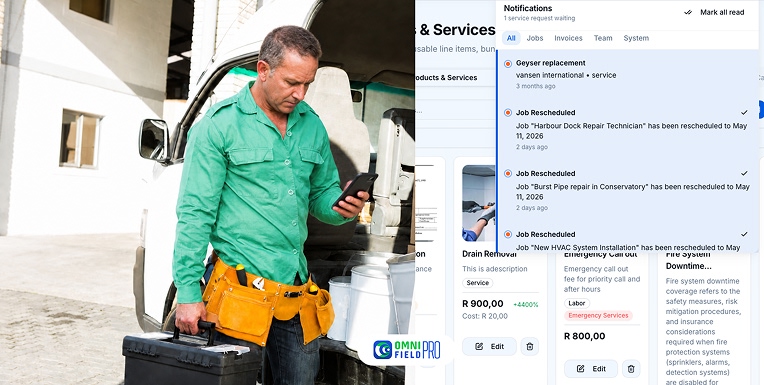
There is a specific moment that catches almost every South African field service owner off guard.
At 3 technicians, you can run the whole operation from memory. You know who's on-site, what they're working on, and roughly when they'll be done. WhatsApp works. A shared calendar works. You work.
At 10 technicians, that system collapses.
Jobs slip through text threads. Invoices pile up because nobody has a clean record of what was actually completed. A tech arrives at the wrong address because the job brief was scrawled on a scrap of paper. You're spending your mornings on the phone doing logistics instead of running a business.
This is the 5-25 technician inflection point, and it's where most field service businesses in South Africa either find a system that scales, or stall out.
This guide is built for that moment. It covers the six operational pillars that separate field service businesses that grow profitably at this team size from those that grind themselves into the ground trying.
1. Scheduling: Move from 'Who Can I Call?' to a System That Assigns Automatically
Ad-hoc scheduling, built on phone calls, text threads, and personal calendars, works at small scale because one person holds the entire picture in their head. Add five more technicians and that picture falls apart. Double-bookings happen, and jobs get assigned to whoever picks up the phone first, not whoever is closest or most qualified.
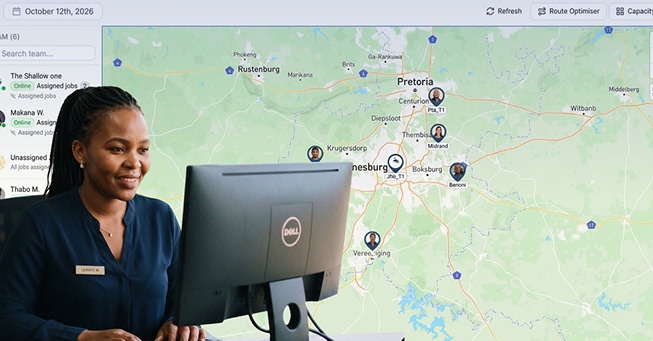
The fix isn't hiring a full-time scheduler. It's replacing the mental model with a digital dispatch board that shows you, at a glance:
- Every open job and its priority
- Every technician's current status (available, on-site, travelling, off)
- Which tech is geographically closest to an incoming callout
- Skills and certifications against job requirements
When your scheduling lives in one place, not split across five people's phones, multiple team members can view and update the same source of truth. A callout that comes in at 07:30 gets dispatched in two minutes, not twenty.
The rule of thumb for 5-25 tech teams: if your dispatcher spends more than 15 minutes per job working out who to send, your scheduling process is costing you jobs.
2. Dispatch: Give Your Techs Context, Not Just a Job Number
Scheduling and dispatching are not the same thing, and conflating them is one of the most expensive mistakes a growing team makes.
Scheduling answers: When does this job happen, and who is going?
Dispatching answers: What exactly does the tech need to know before they arrive?
Without proper dispatch context, technicians show up without scope notes, without the customer's service history, without the materials list, and either spend 20 minutes on the phone with the office, or make an educated guess that results in a second visit.
A second visit costs you a job slot, fuel, and customer trust.
For a 5-25 technician team, every job sent to a tech in the field should include:
- Customer and site details (address, access instructions, key contact)
- Job brief (scope, reported fault, customer notes from the original call)
- Service history (what was done last time, any parts replaced)
- Parts to carry (pre-populated from job type or asset history)
- Photo or form requirements (what proof of completion is expected)
When this travels with the job on a technician's mobile, not in a phone call, your first-time fix rate goes up and your callbacks go down. Both of those directly improve your revenue per tech per day.
3. Job Cards: Going Digital Closes the Billing Gap
Paper job cards are the single biggest revenue leak in South African field service businesses at this team size. Not because they're inaccurate, though they often are, but because of what happens after they leave the technician's hands.
- Cards go missing between the vehicle and the office
- Handwriting is illegible; office staff re-interpret billable hours
- Cards surface two or three days after job completion, delaying invoicing
- Work done that never reached a card never gets billed
For a team of 10 technicians running 6 jobs each per day, even one missed billable item per tech per week adds up to 60 lost line items a month. At an average job value of R1,500 per item, that's R90,000 a month in unbilled work walking out the door.
Digital job cards solve this in three ways:
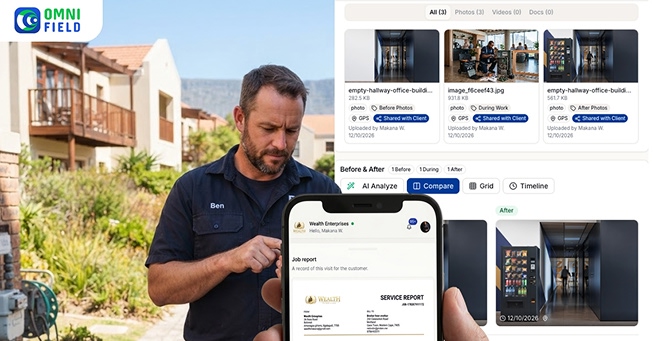
- Instant submission, techs complete the job card on mobile and submit the moment the job is done. The office sees it in real time.
- Mandatory fields, the system won't let a tech close a job without capturing time, parts used, and a customer signature.
- Direct invoice generation, completed job cards trigger invoice creation automatically, collapsing a multi-day cycle to same-day billing.
For trades businesses, plumbing, electrical, HVAC, security, refrigeration, this is where the ROI on field service software pays for itself fastest.
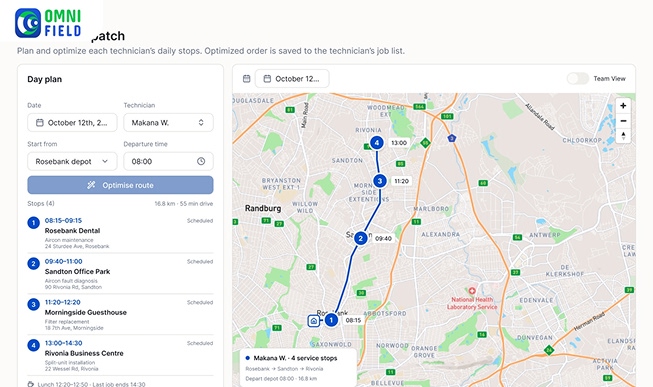
4. Route Optimisation: Fuel and Overtime Are Margin Killers at Scale
At 3 technicians, route planning is informal and it mostly works. At 15 technicians running across Johannesburg, Cape Town, or Durban, unoptimised routing becomes a major cost centre.
The pattern is predictable: without route logic, techs zigzag across their service area, spending more time behind the wheel than on-site. The result is overtime, excess fuel spend, and fewer completed jobs per day per technician.
Research on dispatch operations consistently shows that teams implementing route optimisation tools report meaningful labour cost savings, and those savings compound as the team grows and job volumes increase.
For SA businesses specifically, route efficiency is amplified by:
- Fuel costs, petrol and diesel prices remain a significant operating expense for any fleet
- Traffic conditions, peak-hour congestion in metros like JHB and CPT can double travel times for poorly sequenced routes
- Load shedding, techs on extended routes during outages lose communication with dispatch, and jobs at loadshed sites may require timing around power schedules
A practical target for a 10-20 technician team: cluster jobs by geography each morning, sequence callouts by proximity, and build in buffer time for urgent reactive callouts. Good software does this automatically as jobs come in through the day.
5. Real-Time Field Visibility: The Office Should Never Be Blind
One of the most common frustrations for operations managers at this team size is described the same way everywhere: 'Between dispatch and when the tech returns, we know nothing.'
Customers phone in asking for an ETA. The answer is a callback while someone rings the technician. The technician is on a roof and can't answer. The customer gets a vague estimate. The customer is unhappy.
Multiply this by 15 technicians and 8 jobs each, and your office team spends most of their day doing status calls instead of processing new work.
Real-time field visibility means:
- Live job status, tech has accepted the job, is travelling, is on-site, has completed
- Digital sign-off, customer signature captured on mobile the moment the job is done
- Photo evidence, before-and-after photos attached to the job record, not stored on a personal phone
- Instant updates, if a job overruns or a tech hits a problem requiring parts, the office knows immediately and can reschedule downstream jobs
For client-facing businesses, especially those with SLA contracts, this visibility is the difference between confidently reporting compliance and scrambling at month end.
6. Quoting and Invoicing: Speed Is a Competitive Advantage
At 5-10 technicians, slow quoting is annoying. At 20-25 technicians, it's a growth ceiling.
A customer who calls three plumbing contractors gets a quote the same day from one of them. Unless your service or reputation is dramatically superior, that contractor wins the job. Speed of quote is a conversion factor that most field service owners underestimate.
The same logic applies to invoicing. A job completed on Monday that only gets invoiced on Friday has a cash flow cost. For a business running 100+ jobs a week, that delay is the difference between a healthy bank balance and chasing debtors.
The 5-25 tech team benchmark to aim for:
- Quote turnaround: same day for standard jobs, 24 hours for complex scoped work
- Invoice generation: same day as job completion, ideally triggered automatically from the completed job card
- Payment follow-up: automated reminders at 7, 14, and 30 days, not manual chasing by the owner
Field service management software that connects your job cards directly to your quoting and invoicing removes the manual handoff between field and finance, the biggest time sink in most SA service businesses at this growth stage.
The System That Ties It Together
None of these six pillars works in isolation. The business that solves scheduling but still uses paper job cards still has a billing gap. The business that goes digital on job cards but has no route logic still has a fuel and overtime problem.
The leverage is in connection:
Booking → Scheduling → Dispatch → Digital Job Card → Real-Time Status → Auto Invoice
When every hand-off in that chain is digital and connected, your office team stops being a coordination call centre and starts being a growth engine. Your technicians stop being logistics problems and start being revenue assets.
For South African field service businesses in the 5-25 technician band, plumbing, electrical, HVAC, solar, security, cleaning, refrigeration, maintenance, this is the operational model that separates the businesses growing at 30%+ per year from those grinding sideways.
The good news: you don't need to boil the ocean. Pick the biggest leak first. For most businesses at this stage, that's either the scheduling chaos or the paper job card billing gap. Fix one, see the return, then expand.
Running a field service team in South Africa? Omni Field is built specifically for SA service businesses at this growth stage, mobile job cards, dispatch scheduling, live job tracking, quoting, and invoicing in one platform, built around local conditions. Start a free trial and see how it fits your operation.