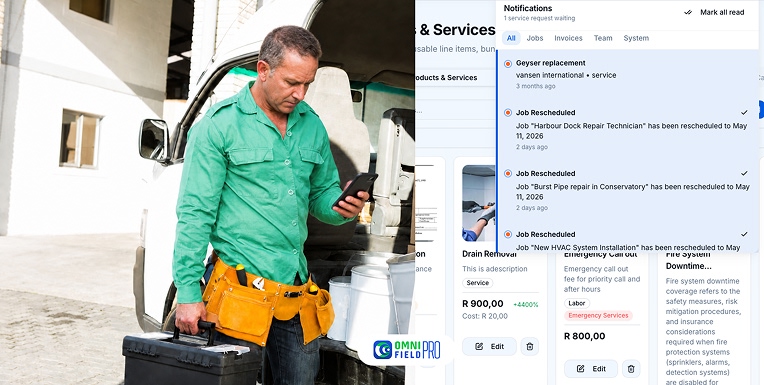
There's a ceiling that almost every South African trade business hits at 3-5 technicians. The owner is fully utilised. Every technician is booked solid. Revenue has plateaued. And the solution, hiring another technician, feels impossible because the margin isn't there, the admin would increase, and honestly, there's no time to find, interview, and onboard someone new.
This is the growth trap. And most SA plumbing, electrical, and solar businesses stay stuck in it for years.
The answer, counterintuitively, isn't more people. It's more capacity from the people you already have. Research by McKinsey shows that field service businesses typically have 35-45% hidden capacity in their existing teams, capacity that's consumed by inefficient scheduling, admin overhead, duplicate data entry, and unnecessary repeat visits.
This guide covers how to unlock that hidden capacity using systems and software, not headcount.
Growth Bottleneck 1: Scheduling Inefficiency
The biggest hidden capacity drain in most field service businesses is scheduling, specifically, the gap time between jobs. A technician with 5 jobs scheduled across a day may spend 40% of their working time in transit if those jobs are routed inefficiently.
Route optimisation in Omni reorders the day's jobs by geography automatically, grouping jobs in the same area together and sequencing them to minimise backtracking. For businesses with 4+ technicians operating across a metro area, route optimisation typically recovers 1-2 hours of billable time per technician per day, time that was previously spent on the road between jobs.
At a billing rate of R350/hour, recovering 1.5 billable hours per technician per day across 4 technicians generates an additional R2,100 per day, over R40,000 per month, without a single new hire.

Growth Bottleneck 2: Admin Overhead
In a typical 4-technician plumbing or electrical business running on paper, the owner or office manager spends:
- 45-60 minutes per day scheduling and dispatching jobs manually
- 30-45 minutes per day following up on job card returns from technicians
- 60-90 minutes per day creating and sending invoices
- 30 minutes per day following up on outstanding payments
- 60-90 minutes per week preparing payroll from time records
That's approximately 15-20 hours per week of pure admin. Time that could be spent winning new contracts, managing client relationships, or delivering more jobs.
Omni automates all of it. Scheduling is managed in the calendar with conflict detection. Job cards are submitted digitally from the field. Invoices are generated automatically at job completion. Payment reminders fire on schedule without manual follow-up. Time records are captured by GPS and compiled automatically for payroll.
Businesses that automate this admin overhead report recovering 12-18 hours of management time per week, time that effectively doubles the strategic capacity of the business without adding headcount.
Growth Bottleneck 3: Technician No-Shows and Late Arrivals
Every time a technician doesn't arrive on time or doesn't arrive at all, the business pays twice: the client's time is wasted (creating a retention risk), and the technician's day is disrupted (creating a scheduling cascade).
GPS geofencing and automated morning job briefings have a measurable impact on no-show rates:
- Technicians who receive an automated morning briefing (list of today's jobs with addresses and customer names) at 07:00 show up 23% more reliably than those who receive verbal instructions at the depot
- GPS check-in requirements, which create an objective record of arrival time, reduce late arrivals by 31% compared to honour-system time logging
- Geofence alerts (manager notified if a technician hasn't arrived within 20 minutes of schedule) allow proactive client communication before the client calls to complain
How to Scale from 2 to 10 Technicians Without Chaos
The businesses that scale successfully from 2 to 10 technicians share a common pattern: they systematise operations at 2-3 technicians, before the complexity requires it, so that adding more technicians is simply adding more capacity to a working system rather than trying to build the system while under operational pressure.
The key systems to put in place before scaling:
- Digital job management, every job has a record, every technician has a mobile app, every customer communication is automated
- Standard job checklists, what every technician does on every job type is documented and required, not optional and variable
- Inventory management, vehicle stock levels are known, reorder points are set, materials are logged against jobs automatically
- Performance tracking, FTFR, utilisation, and satisfaction scores are tracked from day one, so you know which behaviours to reinforce as you hire
With these systems in place, adding a new technician is straightforward: load them into Omni, set their skills and certifications, issue the mobile app, and they're productive on day one, with full visibility into their performance from the start.
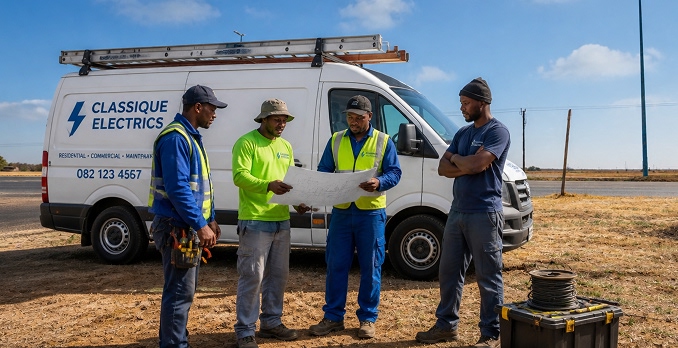
Professional Services Software for South Africa's Trades
International field service software wasn't built for South African businesses. The pricing is in foreign currency. The payment integrations don't include Paystack. The support operates in time zones that don't overlap with SAST business hours. And the features are designed for mature, large-enterprise field service operations, not the 3-15 technician businesses that represent the backbone of SA's trades sector.
Omni is professional services software built specifically for South Africa's skilled trades. Every feature, pricing tier, payment integration, and support model is designed for the reality of running a plumbing, electrical, HVAC, solar, or contracting business in SA, with ZAR pricing, Paystack payments, and SAST support hours.
Solar Business Management: Managing Rapid Growth
South Africa's solar installation sector grew by over 300% between 2021 and 2024. Businesses that entered the market early are now managing installation backlogs of 2-4 months, multi-site project crews, and supply chain complexity that didn't exist two years ago.
Omni's multi-phase project management handles the solar growth challenge: each installation is a project with phases, team assignments, compliance checklists, and budget tracking. As the backlog grows, the system scales, a 20-project pipeline is managed with the same interface as a 5-project one.
Scale Smarter, Not Harder
Route optimisation, admin automation, technician accountability tools, scalable project management, and professional services software designed for SA's trades, all in Omni. Start your 14-day free trial, no credit card, no setup fees.