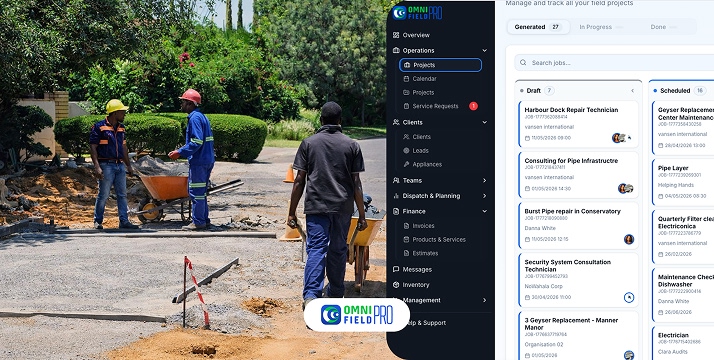
Why Mobile Workforce Management Matters in SA
South Africa's field service industry is uniquely challenging. Vast distances, unreliable connectivity, and diverse operating environments mean that mobile workforce solutions must be robust, offline-capable, and designed for local conditions.
Here are three case studies showing how South African businesses transformed their operations.
Case Study 1: Cape Town Plumbing Company
The Challenge
A 20-technician plumbing company serving the greater Cape Town area was struggling with:
- Paper-based job cards getting lost or damaged
- No visibility into technician locations during the day
- Invoicing delays of 30+ days after job completion
- Customer complaints about missed appointment windows
- Difficulty tracking warranty work and repeat visits
The Solution
After implementing a mobile workforce management platform:
- Digital job cards replaced paper entirely, technicians capture all details, photos, and signatures on their phones
- Real-time GPS tracking gave dispatchers visibility into team locations
- On-site invoicing eliminated the paper-to-office delay
- Automated customer notifications provided ETAs and job updates
- Job history search made warranty tracking instant
Results After 6 Months
| Metric | Before | After | Change |
|---|---|---|---|
| Average invoice cycle | 34 days | 8 days | -76% |
| Missed appointments | 12% | 3% | -75% |
| Jobs completed per tech/day | 4.2 | 5.8 | +38% |
| Customer satisfaction | 72% | 91% | +26% |
Case Study 2: Johannesburg Electrical Contractor
The Challenge
A commercial electrical contractor with 35 technicians across Gauteng faced:
- Complex compliance requirements (CoC certificates, ECSA regulations)
- Multi-site projects requiring coordinated scheduling
- High admin overhead for job allocation and reporting
- Parts tracking across multiple vehicles and warehouses
The Solution
The company adopted FSM software with:
- Digital compliance certificates generated and signed on-site
- Multi-job scheduling with drag-and-drop dispatch
- Automated reporting for project managers and clients
- Inventory management with per-vehicle stock tracking and automated reorder alerts
Results After 12 Months
- Compliance certificate generation time reduced from 2 hours to 15 minutes
- Admin staff reduced from 4 to 2 (redeployed to customer service)
- Parts wastage reduced by 28%
- Monthly revenue increased 22% through improved capacity utilisation
Case Study 3: Durban Facilities Management Company
The Challenge
A facilities management company maintaining 45 commercial properties in KZN struggled with:
- Reactive maintenance draining budgets
- Tenant complaints about slow response times
- No visibility into asset condition across properties
- Subcontractor coordination inefficiencies
The Solution
Implementation of a comprehensive FSM platform enabled:
- Preventive maintenance scheduling based on asset service intervals
- Tenant self-service portal for logging maintenance requests
- Asset tracking with full service history per item
- Subcontractor management with digital work orders and sign-off
Impact
"We went from fighting fires every day to running a proactive operation. Our tenant satisfaction scores went from 65% to 89% in eight months.", Operations Manager
Key Takeaways
- Start with your biggest pain point, Don't try to digitise everything at once
- Mobile-first is non-negotiable, Your team works in the field, not at desks
- Offline capability is essential, South African connectivity is unpredictable
- Measure what matters, Track metrics before and after implementation
- Invest in training, Technology is only as good as the people using it